PALIMPSESTS
Małgorzata Dawidek
blackShed are very excited to be working with Małgorzata Dawidek on this solo exhibition, as part of Coastal Currents 2026
Curated by Lorna Ough
Opening Event - Saturday 10th October, 2:00-4:00pm
Exhibition on show between 10.10.26 until 14.11.26
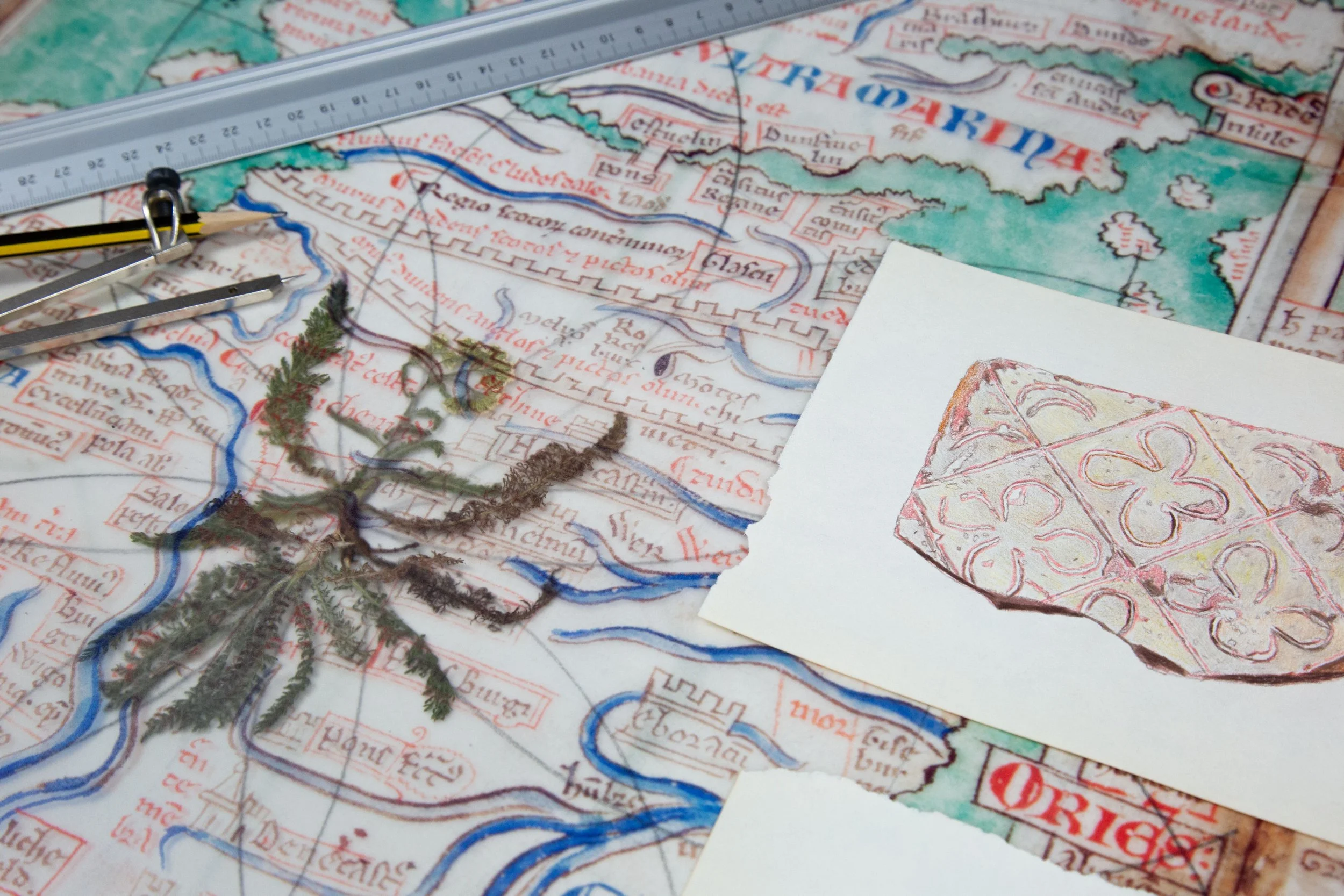
Palimpsests is a body of work by Małgorzata Dawidek that emerged from her artistic residency at Hastings Museum & Art Gallery. Drawing on descriptions of the natural world in the writings of Marie de France (c. 1160–1215), regarded as the very first British female author, the artist has created a photographic and drawing-based series that reconstructs the natural-cultural landscapes of 12th and 13th Century England’s southern coast – places shaped simultaneously by natural processes and by human presence, memory, history and imagination.
Moving away from traditional ways of illustrating stories, Dawidek focuses on documenting the realities of Marie’s period: both those described by the poet in Lais and Fables, and those preserved in material culture. In the course of her research, she collaborated with curators of medieval collections, studying artefacts held by Hastings Museum & Art Gallery, Bexhill Museum and Winchelsea Court Hall Museum. Her investigation also involved documenting objects, polychrome decoration and graffiti in the medieval churches of East Sussex – All Saints in Old Town Parish in Hastings, St Peter’s in Bexhill-on-Sea Old Town, and St Thomas of Martyr in Winchelsea, as well as at Dover Castle, Hastings Castle and Pevensey Castle. Alongside this, she examined medieval maps of England held by the British Library in London, the Bodleian Libraries in Oxford and the Roman-Britain Archive, looking for references to places she encountered while walking along the coastline and recording, from above, contemporary views of the shore – its natural environments and architecture.
Dawidek focuses on nature, which is a central protagonist in Dame Marie’s narratives. She draws on their embodied, animistic and fantastical vision of the world, as well as on the relationships they establish between human beings, the natural world and supernatural forces.
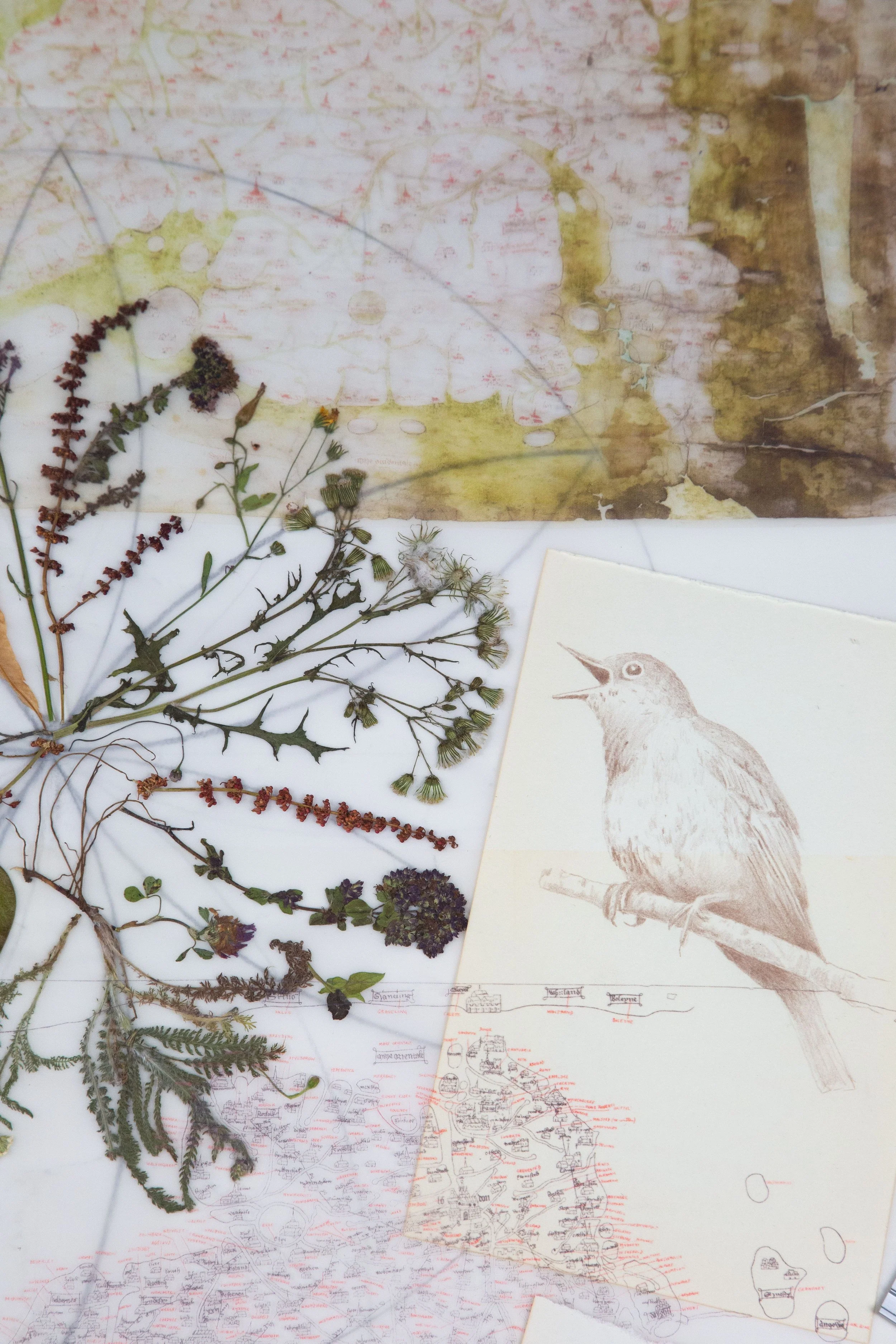
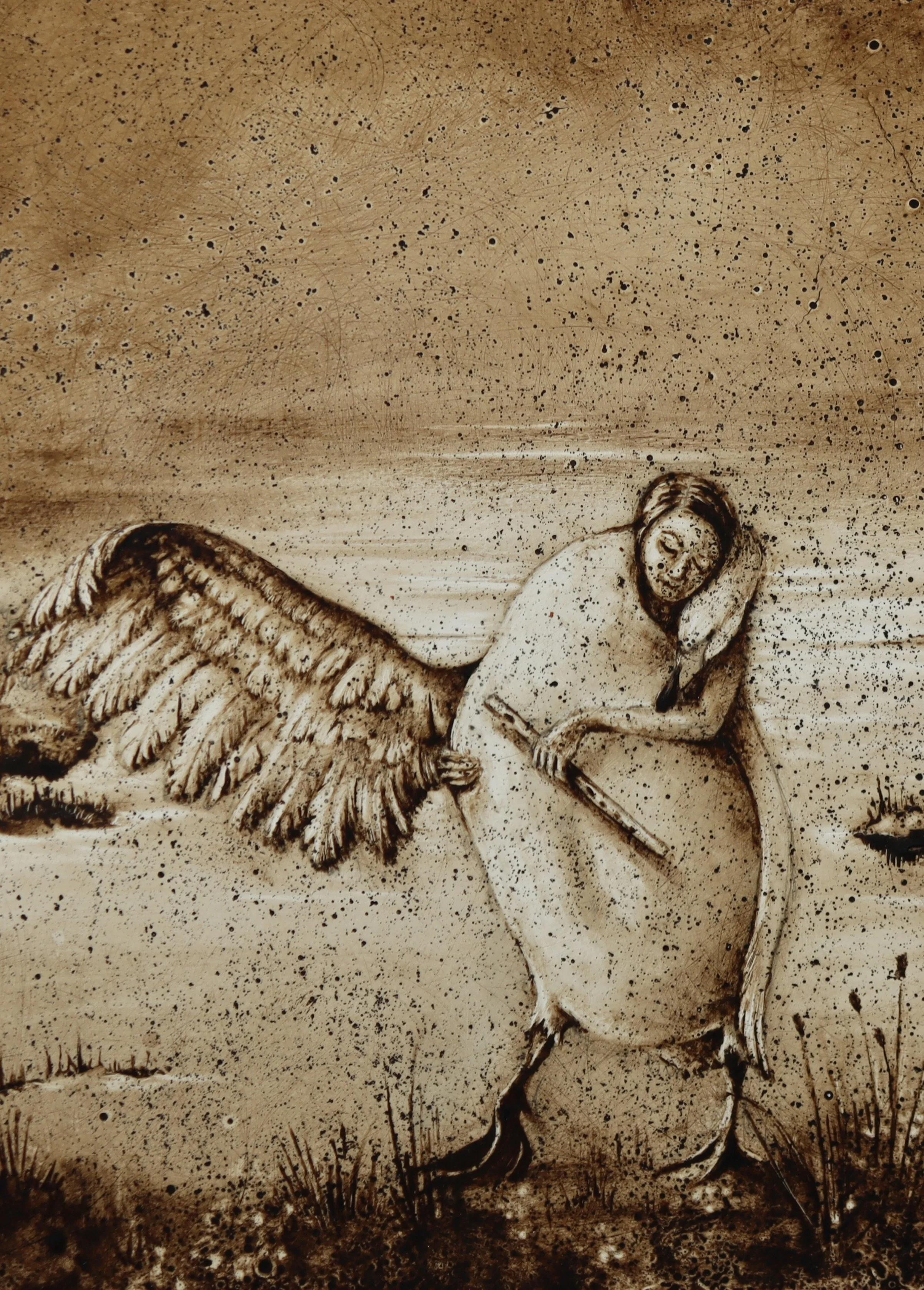
The series presented at blackShed Gallery comprises photographs, cartographic elements and finely detailed hand-drawn works. Aerial records of the contemporary shoreline meet the lines of medieval maps, reconstructions of signs attributed to witches, traces of pigment derived from local clays, fragments of flora, drawings of historical artefacts and depictions of the animal world in Marie’s narratives. By juxtaposing the patterns and forms of archival objects with contemporary documentation, Dawidek creates a multi-layered visual essay on the traces of the past along England’s southern coast – its natural environments, places, people, legends, rituals and corporealities – opening a dialogue between times and spaces.
Created at the intersection of art, literature and archaeology, the series foregrounds the significance of time and its role in shaping place and its history. Works made on transparent papers materialise this idea. They render time as an assemblage – overlapping planes and a living tissue that shifts and remains active in the present.
Integral to the project are objects collected by the artist during her walks along the English Channel, in the areas of Portsmouth, Pevensey, Bexhill, St Leonards, Hastings, Rye, Winchelsea and Dover. These include ceramic sherds, geological materials, botanical elements and other natural matter. Some may have already existed within the landscape during Marie de France’s lifetime. Within the series, they function as material evidence of the continuity and transformation of place – fragments that have survived across successive periods, carried and displaced by people, water, wind and geological processes.
On the Processes and Methods of Working on the Project
“Throughout the creative process, I kept returning to the question of what the British coastline might have looked like in the time of Dame Marie. What might she have seen when she arrived in England from Brittany, the place of her birth? At which port did her ship come ashore? What objects might she have used? Which plants have survived from her time to the present day? Although little is known about the author herself, both the natural world described in her Lais and Fables and the reality in which Marie de France lived and worked seemed to me deeply material. While working on Palimpsests, I sought traces of her in contemporary cultural-natural landscapes.
Bringing together artistic, historical, and archival research in museum collections and libraries with methods such as walking, working with found objects, reviewing marginalised and fictional female narratives, and imaginative cartography enabled me to develop alternative methodologies for knowledge production and representation. Crossing disciplinary boundaries, I grounded my process in producing knowledge rooted in lived bodily experience rather than in abstract theories of art and literature. This is why Palimpsests emphasises the significance of time, movement, affect, and the moment of material contact with a place or object – what is often referred to as situated experience. My body, moving along the shoreline and coming into contact with historical artefacts, becomes an active tool of both research and artistic practice.
Such a methodology places my practice at the opposite pole from hierarchical systems of knowledge, patriarchal traditions of representation, and disembodied models of cognition. At the same time, I challenge anthropocentric ways of thinking that position the human body as separate from, or superior to, nature. Through landscape archaeology and engagement with material cultural heritage, I understand the human body and the body of nature as materially connected and mutually dependent. The landscape is not, for me, a passive backdrop to human history, but an active participant in it – retaining, transforming and transmitting the traces of different forms of life. A multispecies assemblage.
In working on the project, Marie de France’s imagination played a particularly significant role. In her narratives, the boundaries between the human, animal and natural worlds remain fluid: animals take on human form, humans undergo metamorphosis, and the forces of nature possess an agency of their own. This animistic dimension of her stories allowed me to approach the natural-cultural landscape as an organism whose interspecies elements remain in constant relation. Palimpsests, like my practice as a whole, therefore challenge rigid divisions between art, science, history and ecology, proposing instead a way of thinking grounded in interdependence, ecological embodiment, and a politics of care arising from vulnerability and material entanglement.
I hold a deep conviction that archives are never neutral. They are not closed records of the past, but living matter, bound together with the landscape, which can be reactivated through the body, imagination and the experience of place. They only need to be revisited.”
London, 6 September 2026
___________________
The artist would like to extend her special thanks for the support and expertise provided during the realisation of the project to:
Philip Hadland, curator of the Mediaeval Collection of Hastings Museum & Art Gallery
Julian Porter, curator of Bexhill Museum
Jo Turner, curator of Winchelsea Court Hall Museum
Lynn Cornwell, Hastings Area Archaeological Research Group
Fr Mathew Phipps, Priest-in-Charge Hastings Old Town Parish
Richard Hemery and mudlark community
This exhibition was organised with the support of
Hastings Museum & Art Gallery
Adam Miciewicz Institute
ZAiKS
The Eaton Foundation
COMING UP NEXT… Remembren by Ibby Lanfear
Remembren: a 14th century, middle English word meaning to keep, or bear someone in mind.
Never more obvious in the UK than in the drought this summer, it seems we are in a period of transition, a liminal moment when we are mourning the end of the world we have known and are as yet unsure how to traverse the new. The work in this exhibition represents an ongoing search for a practice that brings us back into relationship with the living Earth and the many others with whom she is shared. Turning towards evidence offered by our Mesolithic ancestors in a quest for more reciprocal ways of being, here making becomes a visceral art of recognition and remembrance; an act of care, and quiet resistance within the dominant ‘unmaking’ of life that is the Anthropocene.
In a process deeply rooted in the particular materiality of place, natural pigments are found and foraged, grown and harvested. Earth is sifted and washed; bones charred in the absence of air; plants simmered and laked; panels made to an original 14th century recipe. The pieces are collaborative, relational, and in looking backwards perhaps suggest ways to move forwards: towards empathy, reciprocity, and the development of new rituals that might allow us to grieve the loss of the old, while tentatively stepping, with hope and fear, into the new.
Our annual Winter Exhibition at blackShed, Remembren opens with a special preview event on -
Saturday 28th November, 2-4pm
It will run until the end of January 2027
Past Exhibitions: